Dr Mike's Hospital Toolkit
Your medical history on eight pages, written down once at home and ready to hand over if you or a parent is admitted.
In my experience the doctor who admits you often has about 15 minutes to take your whole history. What you can tell them in that time shapes the first decisions they make. A review of 22 studies found that up to two in three patients had at least one error in the medicine history taken at admission (Tam et al, CMAJ 2005). The toolkit puts that history on paper before you need it.
If you are the one the family calls when someone is admitted, fill in one for each parent first. Then fill in your own.
Get the toolkit
Leave your email and the download opens straight away. Over the next two weeks I will send five short emails that take you through it one page at a time.
Dr Michael Taylor (BiosyncX) keeps your email with our form provider Netlify, which is in the United States. Your address is used only for these emails. I never ask for health information here. The toolkit sends nothing to us. What you write stays on your phone or your paper unless you choose to share it.
Anyone who holds the file can read it. Keep it on a phone with a passcode and send it to family privately.
Two ways to keep it
- On your phone. Open the PDF on the phone, fill it in there and keep it in your Files app. Send a copy to your next of kin.
- On paper. Print it, fill it in with pen with every pill bottle, discharge summary and clinic card beside you and keep it on you. Give a second copy to whoever would drive you to hospital.
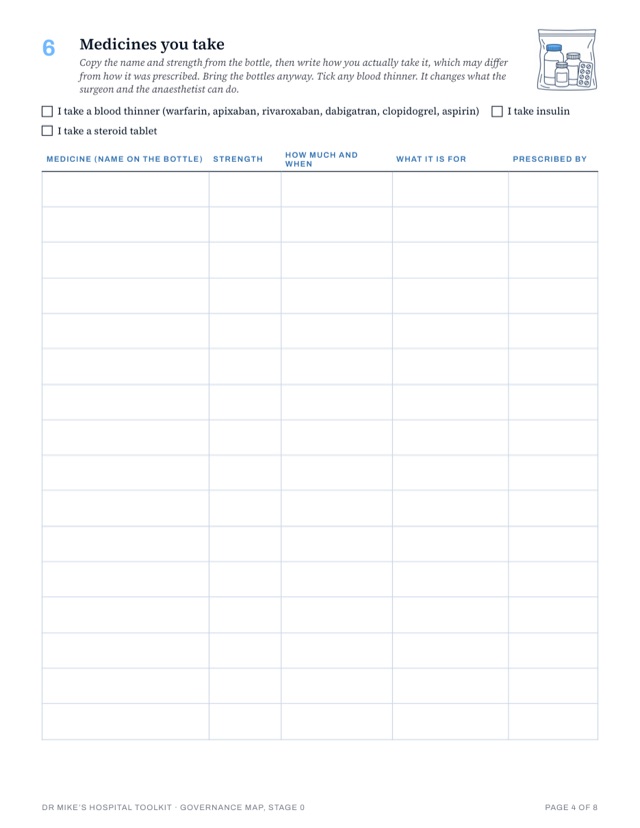
Eight pages: who you are, who to call, your clinics and doctors, the conditions you have been treated for, hospital stays, every medicine, allergies and what actually happened, operations and implants, your family history, your habits said plainly, what to pack, the five questions to ask before you leave and a page for the discharge diagnosis and the first week home.
Why write it down
The admitting team works from what it can learn in the first few minutes. Medicines, allergies, blood thinners and implants are the details that change what can safely be done. The last page covers the discharge diagnosis in plain words, the first week home and when to call 811 or go back the same day.
In one study about one in five people had an adverse event within about three weeks of going home. Two thirds involved medicines and nearly a third were judged preventable (Forster et al, Annals of Internal Medicine 2003).
Where it leads
The toolkit is stage 0 of the Governance Map. Stage 0 describes how care is organised and says nothing about your health. When the toolkit is filled in, count the fields you could not answer.
The Governance Map is also free. It places how your care is organised on stages 0 to 6 and shows the next step up. For anyone who wants the measuring and the planning done in one place, the map explains where the Audit fits. Any follow-up after a hospital stay remains with the team that treated you.
Questions
- Is it free?
- Yes. The download opens as soon as you leave your email.
- Does the toolkit send my information anywhere?
- No. It is a PDF. Nothing you write leaves your phone or your paper unless you share it.
- Can I share it?
- Please do. Send people to this page.
- Can a hospital or clinic hand it out?
- Yes. My Hospital Passport is the unbranded edition and is free to copy at biosyncxglobal.com/passport.
- Is it medical advice?
- No. It is an organiser for your own records and does not replace the doctors who treat you.
For leaders: the AI Inventory Sheet is on its own page.